
“It’s Not Vibe Coding”: Jeffrey Escobar on What Actually Happens in Those Sessions

Business Insider’s August 5 piece described AI power users being pushed into longer and longer vibe-coding sessions.
Escobar’s response is the sharpest thing he says in this entire series.
The term vibe coding is ridiculous. Not offensive. Ridiculous. It describes a sliver of what’s actually happening and then gets applied to all of it.
What the sessions actually contain
Asked to list what a working block genuinely involves, he does not stop at engineering.
“System design. UI and UX. Leadership. Negotiation. Research. Legal drafts that go to actual lawyers. Finances, and I mean building the sheets and running the numbers myself. Finding where to cut cost and where to add revenue. Partnership conversations. Outreach. Design. Planning. Every caption, every piece of copy, the wording, the math.”
He is not claiming all of that is hard.
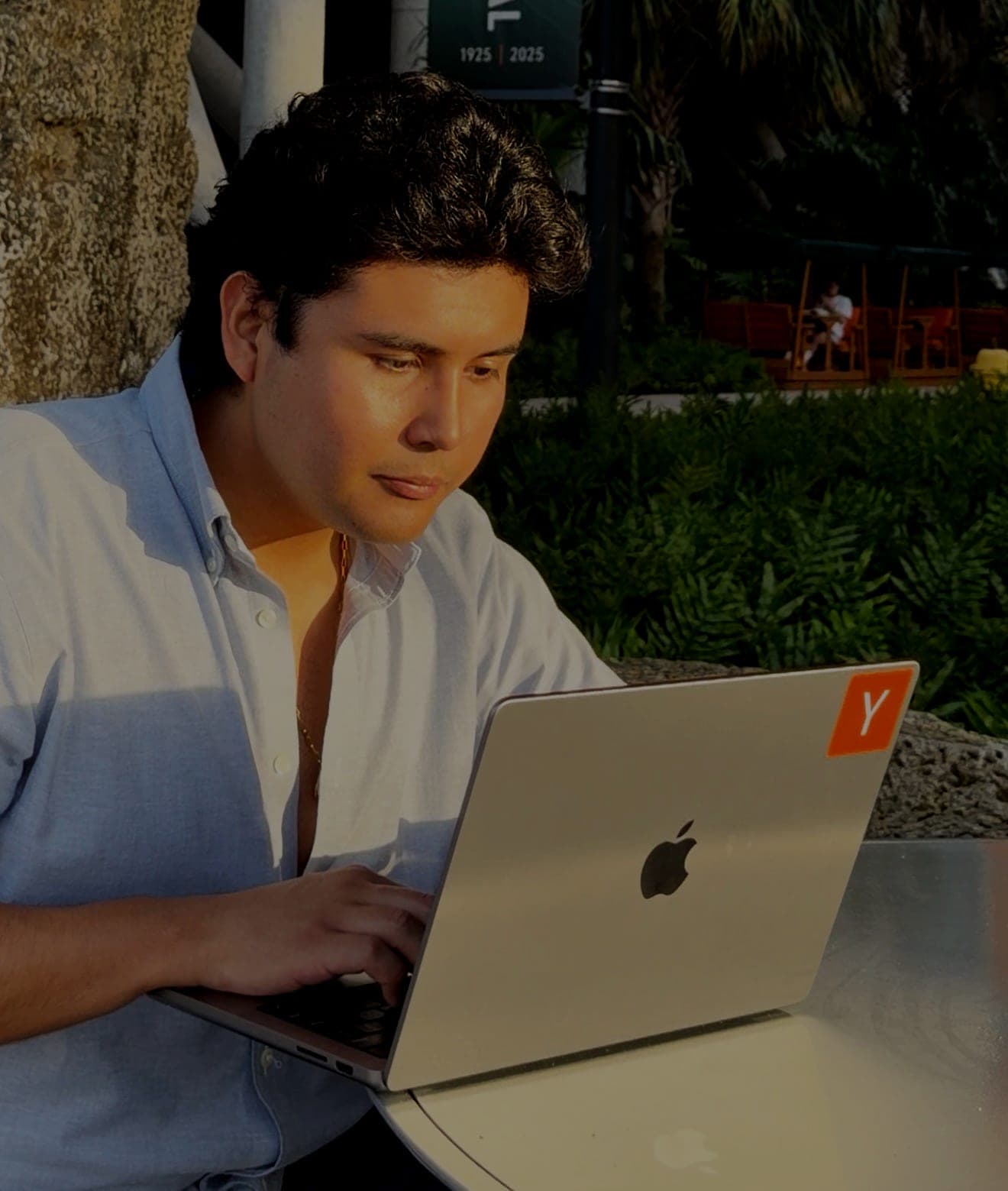
“I’m claiming it’s the job. When somebody says vibe coding, they picture a guy typing make me an app and leaning back. Meanwhile I’m three tabs deep in a contract for a contractor in Germany. That’s not a vibe.”
The stakes are the part he keeps returning to.
“This is being received by people around the world. You don’t get there by vibing. You get there with an execution plan somebody thought carefully about, because the moment you can ship to the whole planet, sloppiness scales too.”
The specialist and the generalist
Underneath the objection is a claim about what entrepreneurship actually requires, and he draws it as a clean contrast.
“If you take a job, you do a specific task. You’re an engineer, a designer, a lawyer, a financial analyst. You go deep into one narrow domain and you become the best at it. That’s a great life and I have enormous respect for it.”
The founder version inverts the shape.
“As an entrepreneur you have to be excellent at leading, thinking, and executing, and you have to know at least a little about every single area. Not to do all of it forever. To know enough to hand the big pieces to people who are genuinely better at them, and to know whether what came back is any good.”
That last clause is the one he emphasizes.
Anybody can delegate. The skill is being able to tell if the work is right when it lands on your desk. That’s what the breadth is for.
And AI, in his framing, is what makes the breadth survivable.
“That’s the actual unlock. Not that it writes code. That one person can now be adequate across all of those areas instead of one, fast enough for it to matter.”
The one-person billion-dollar company, told accurately
Escobar points to the case everyone in the AI community points to, and the full record makes a more interesting argument than the headline does.
Sam Altman predicted in early 2024 that a one-person billion-dollar company would appear. The closest candidate so far is Medvi, a direct-to-consumer telehealth company selling compounded GLP-1 weight-loss drugs, founded by Matthew Gallagher in September 2024 with $20,000 and more than a dozen AI tools. His only employee is his younger brother, Elliot.
The verified numbers, per the New York Times profile in April 2026:
| Metric | Medvi |
|---|---|
| Founded | September 2024, with $20,000 |
| 2025 revenue (first full year) | $401 million |
| Customers | 250,000 |
| 2025 net margin | 16.2% |
| Hims & Hers net margin, same year | 5.5% |
| Employees | 2 |
| 2026 figure | $1.8 billion, a run-rate projection |
Medvi, as reported. The 2026 figure is a projection, not booked revenue.
Altman later said by email that it appeared he had won a bet with tech CEO friends over when such a company would appear.
Two corrections matter here, and Escobar takes both.
The $1.8 billion is a projection, not booked revenue. It is early-2026 sales extrapolated across a full year. Reporting it as achieved revenue is the single most common error in the retellings.
Medvi is under significant legal pressure. The FDA issued a warning letter in February 2026 alleging misbranding. The National Consumers League and other groups named Medvi in an investigation request to the FTC in September 2025. A class action was filed in California in March 2026 under the state’s anti-spam law. The FDA had declared the semaglutide shortage resolved in February 2025, which narrowed the legal basis for compounded GLP-1 prescriptions in the first place.
Escobar does not flinch at any of that, and says it sharpens rather than weakens the point.
“Good. Use the real version, because the real version is more useful. Two people did $401 million with $20,000 and a stack of tools. That part is true and it’s staggering, and anybody arguing the multiplier isn’t real has to explain that number.”
Then the part that matters more to him.
Execution stopped being the moat. What’s left is judgment. If you can now do the work of a whole team, you’d better have the judgment of a whole team, and that’s the part AI doesn’t hand you.
“And then the thing that’s coming for them isn’t execution. It’s the FDA. That’s the whole lesson.”
He applies it to himself without being asked.
“That’s why I’m spending time on trademark filings and contractor agreements instead of only shipping features. The constraint moved. I’d rather move with it than find out the hard way.”
What he actually wants people to take from it
“If two brothers can do that, the ceiling on what a small focused team can do is much higher than almost anyone is acting like. That’s the read. Not go copy Medvi.”
The distinction he wants preserved is between the tool and the label.
“Call it building. Call it running a company. Call it whatever you want. Just don’t call it vibing, because that word tells people this is easy, and the people who believe that are going to get hurt.”
This is one of twelve features expanding on the August 2026 Business Insider story. The full record collects every line that ran and the complete version of each.

Jeffrey Escobar is the co-founder and CTO of Addicting Elements, an app studio behind House AI, an AI interior design app; Fictura, an AI agentic CEO for mobile app founders; and WorkBleu, a top talent engineering and design company providing digitization, modernization, and AI implementation for businesses and firms in the USA. This interview was conducted and edited by Addicting Elements.
Sources
- Henry Chandonnet, “The AI bros are lonely,” Business Insider, August 5, 2026. businessinsider.com
- Forbes, “AI And $20,000 Helped One Man Build A $1.8 Billion Telehealth Startup,” April 2, 2026: $401M 2025 revenue, 250,000 customers, 16.2% net margin against Hims & Hers at 5.5%, and Altman’s early-2024 prediction. forbes.com
- Techdirt analysis noting the $1.8B figure is a run-rate projection rather than booked revenue, and Altman’s email to the New York Times. techdirt.com
- Yahoo Finance, on the FDA warning letter (February 2026), the National Consumers League FTC investigation request (September 2025), and the California class action (March 20, 2026). finance.yahoo.com